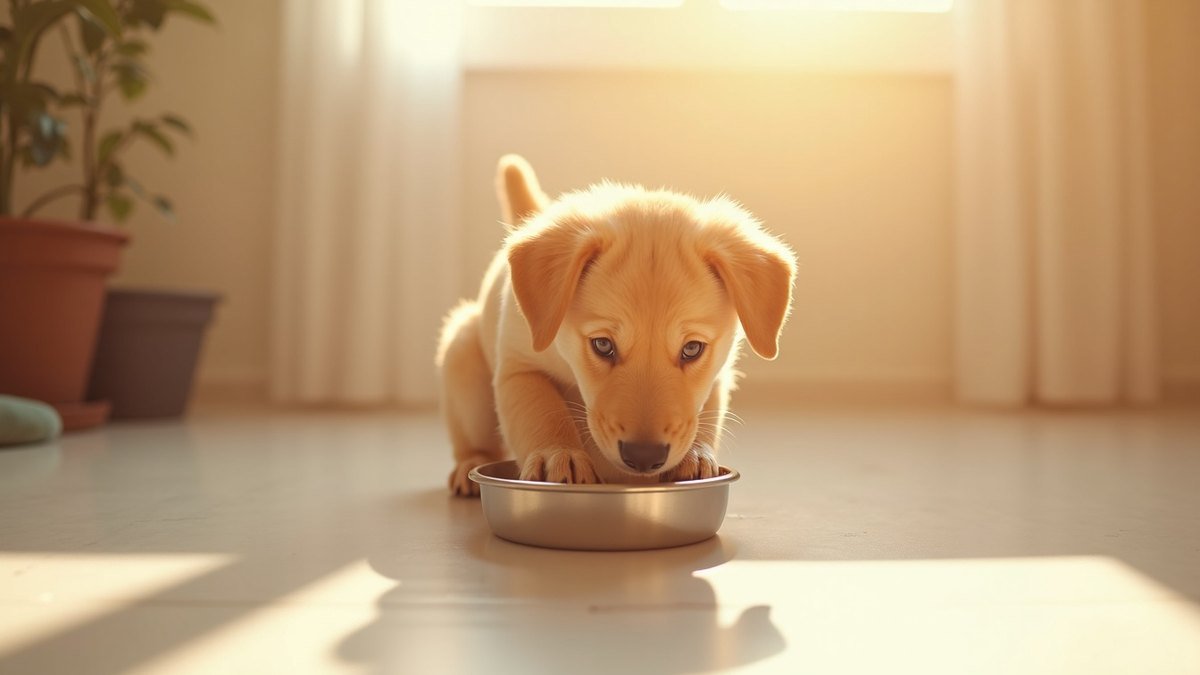
The new-puppy question I heard more than almost any other was some version of "am I feeding this little one enough?" It usually came from a tired but smitten owner holding a wriggling bundle, staring at a giant bag of food with a confusing chart on the back, genuinely unsure whether the recommended amount looked like too much or too little. I get it completely. Puppies grow at a dizzying pace, and the stakes feel high, because you want to fuel that growth without going overboard.
So let me make this simple, the way I tried to make it simple across the exam table. There is no single perfect number that fits every puppy, and anyone who promises one is guessing. What there is, though, is a clear, reliable method: start with the food label as your baseline, divide it into the right number of meals for your puppy's age, and then adjust based on what your puppy's actual body is telling you. Do that, and you will feed your puppy beautifully through every stage.
The short answer
- Start with the feeding guide on your puppy food bag, matched to your puppy's current weight and expected adult size, then split it across the day.
- Feed roughly four meals a day from 8 to 12 weeks, three meals from 3 to 6 months, and two meals from 6 to 12 months.
- Use body condition, not just the chart, as your real guide. You should be able to feel the ribs easily and see a tucked waist.
- Large and giant breeds need a large-breed puppy formula and careful, steady growth, so check feeding amounts with your veterinarian.
Why portion size matters so much for puppies
It is tempting to think a chubby puppy is a healthy, well-loved puppy. I understand the instinct, but the truth is the opposite. Overfeeding a puppy pushes them to grow too fast and carry extra weight, and that strains developing joints and bones at exactly the moment they are forming. In large and giant breeds especially, growing too quickly is linked to orthopedic problems down the road. A lean, steadily growing puppy is the goal, not a roly-poly one.
Underfeeding has its own risks, of course, since puppies need real fuel for all that development. But in my experience, overfeeding was far more common than the reverse. The sweet spot is a puppy who is growing on a steady curve, full of energy, with a body you can keep your hands on and feel the shape of. Getting portions right is not about restriction or indulgence. It is about giving your puppy the right amount of good food to build a healthy adult body.
Start with the feeding guide on the bag
Every complete puppy food carries a feeding chart, and it is your starting point, not your finish line. These charts list a daily amount based on your puppy's current weight, and often their expected adult weight, which matters because a Chihuahua and a Great Dane puppy that both weigh ten pounds today are on very different paths. Find the row that matches your puppy and note the total daily amount. That is the number you will divide into meals.
Two things trip people up here. First, that number is the total for the whole day, not per meal, so do not feed the full amount three or four times over. Second, manufacturers tend to suggest generous portions, so treat the chart as a reasonable middle estimate rather than gospel. Make sure you are feeding a food labeled complete and balanced for growth. The American Veterinary Medical Association's guidance on choosing pet food explains what that label actually means.
How many meals a day by age
Young puppies have tiny stomachs and fast metabolisms, so they do far better with food spread across several small meals than with one or two big ones. Frequent meals keep their blood sugar steady, which genuinely matters for very small breeds, and they make house-training easier too, since what goes in on a schedule tends to come out on a schedule. As your puppy grows, you gradually reduce the number of meals while keeping the daily total appropriate.
Here is the rhythm I taught new owners. From about eight to twelve weeks, feed four small meals a day. From three to six months, drop to three meals. From six to twelve months, move to two meals a day, which is where most dogs stay for life. Giant breeds sometimes stay on three meals a bit longer. The total daily amount is what matters most, so when you reduce meal frequency, simply redistribute that total into fewer, slightly larger portions.
A simple puppy feeding chart
This table gives you a practical starting range. These are general estimates for dry puppy food, and your specific food and puppy will vary, so always cross-check against the bag and your vet. Think of it as a sensible place to begin before you fine-tune with body condition.
| Puppy age | Meals per day | Approx. daily food | Notes |
|---|---|---|---|
| 8–12 weeks | 4 meals | Per bag, by weight | Small, frequent meals; never let tiny breeds skip meals |
| 3–4 months | 3 meals | Per bag, rising with weight | Recheck weight weekly and adjust |
| 4–6 months | 3 meals | Growing portions | Watch the waistline as growth speeds up |
| 6–12 months | 2 meals | Approaching adult amount | Small breeds mature faster than large breeds |
| Large/giant breed, up to 18–24 months | 2–3 meals | Large-breed puppy formula | Aim for slow, steady growth; ask your vet |
Portions by expected adult size
A puppy's expected adult weight changes everything about how much and how long you feed them. Small breeds reach their adult size quickly, often by nine to twelve months, so they spend less time on puppy food and need smaller total amounts. Large and giant breeds keep growing for much longer, sometimes well past a year and a half, and they need more food overall, fed in a way that supports slow, controlled growth rather than rapid bulking.
This is why I always asked owners what their puppy was expected to weigh as an adult. If you adopted a mixed breed and are not sure, your vet can give you a reasonable estimate from paws, frame, and parentage. The food bag's chart usually lets you match both current and projected adult weight, which gives a far more accurate portion than current weight alone. Feeding a future eighty-pound dog like a future fifteen-pound dog is a recipe for getting it wrong.
The special case of large and giant breeds
If you are raising a Labrador, a German Shepherd, a Great Dane, or any other large or giant breed, this section is for you. These puppies must grow slowly and steadily, because growing too fast stresses joints and is linked to developmental orthopedic disease. The single most important step is feeding a food specifically formulated for large-breed puppies, which carefully controls calories, calcium, and other minerals to keep growth in a healthy lane.
Resist the urge to maximize growth. A leaner large-breed puppy that grows a little slower will generally end up with healthier joints than a heavy one that shoots up fast. Keep these puppies on the slim side, feel for those ribs regularly, and do not add calcium or other supplements unless your vet specifically tells you to, because extra calcium can do real harm during growth. When in doubt about amounts, your veterinarian's input is worth far more than any online estimate.
The real secret: read your puppy's body
Here is the part I wish every owner internalized, because it matters more than any chart. The most reliable way to know if you are feeding the right amount is to assess your puppy's body condition, and you can learn to do it in seconds. Run your hands along the rib cage. You should be able to feel the ribs easily, with just a thin layer of cover over them, the way the back of your hand feels when you run fingers across the knuckles. If the ribs are buried, your puppy is carrying too much.
Then look from above. You want to see a waist, a gentle inward tuck behind the rib cage rather than a straight or bulging line. From the side, the belly should tuck up, not hang down. A puppy who is too thin will have ribs, spine, and hip bones that look prominent and feel sharp. Check this every week or two. If the waist is vanishing, trim the portion a little; if ribs are getting too obvious, add a bit. Your hands are the best feeding tool you own.
When and how to switch to adult food
Puppy food is energy-dense and nutrient-rich on purpose, built for growth, so feeding it forever would eventually pack on weight. The timing of the switch to adult food depends on size. Small breeds are usually ready around nine to twelve months, medium breeds around twelve months, and large or giant breeds often not until eighteen to twenty-four months, once their growth has truly finished. Your vet can confirm the right moment for your individual dog.
When the time comes, transition gradually over about a week to ten days, mixing increasing amounts of the new adult food into the old puppy food. A slow change protects your dog's stomach from the kind of upset that a sudden switch can cause. This is the same careful approach I recommend for any food change, and it is especially worth it for dogs with touchy digestion, which I cover in detail in my guide to the best dog food for sensitive stomachs.
Treats, table scraps, and fresh water
Treats are part of raising a puppy, and they are wonderful for training, but they add up fast. The guideline I always shared is the ten percent rule: treats should make up no more than about ten percent of your puppy's daily calories, with the rest coming from balanced food. Go over that and you can throw the whole diet out of balance, plus pile on weight. Use tiny pieces for training, since a puppy values the moment more than the morsel.
Be cautious with table scraps, which are often too rich and sometimes outright dangerous, since foods like grapes, onions, chocolate, and xylitol-sweetened items are toxic to dogs. And never forget fresh, clean water, available at all times, which is just as essential as the food itself. If you are weighing different diet styles while you are at it, my breakdown of grain-free dog food and what the science really says can help you sort marketing from substance.
Common puppy feeding mistakes I saw all the time
A few errors came up again and again, and they are all easy to avoid once you know them. The biggest was free-feeding, leaving a full bowl out all day, which makes it impossible to track intake, complicates house-training, and often leads to overweight puppies. Scheduled meals give you control and information. The second was eyeballing portions instead of measuring, which quietly leads to overfeeding. Use an actual measuring cup or, better still, a kitchen scale for accuracy.
The third mistake was changing foods constantly, chasing the perfect brand, which upsets sensitive puppy stomachs. Pick a good complete puppy food and stick with it. And finally, do not forget that mealtimes shape behavior. A puppy who learns calm patience around food is a joy, while one who is fed amid chaos can grow anxious or pushy. If you notice nervous habits emerging, it is worth learning the early signs of dog anxiety so you can ease them young.
Building a calm mealtime routine
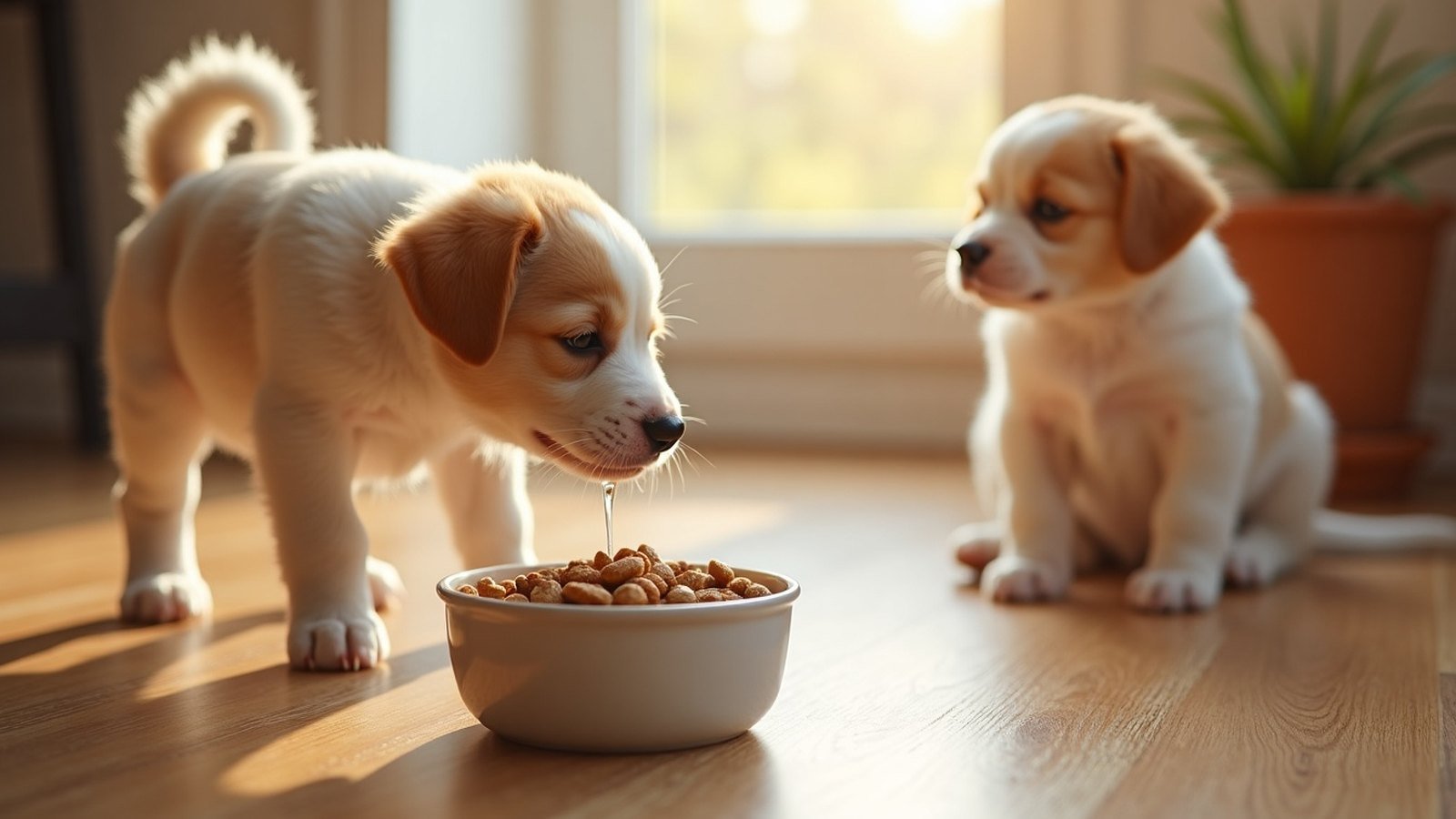
How you feed matters almost as much as how much, because mealtimes shape behavior and digestion together. I always encouraged owners to feed at consistent times in a quiet, low-traffic spot, so the puppy learns to expect food on a schedule rather than begging all day. A predictable rhythm steadies digestion, supports house-training, and teaches patience. Ask your puppy to sit calmly before the bowl goes down, which turns mealtime into an easy daily training moment and prevents the frantic, pushy behavior that can develop around food.
Keep the environment relaxed. In multi-dog homes, feed puppies separately to prevent gulping driven by competition and to make sure each one eats their own portion. Leave your puppy in peace while they eat rather than hovering or taking the bowl away, which can create food guarding, and instead build trust by occasionally adding something tasty to the bowl as you pass. A puppy who feels safe and unhurried at meals grows into a dog who is calm and easy around food for life.
Foods and feeding habits to avoid
A few things do real harm, so they are worth knowing clearly. Never feed puppies foods that are toxic to dogs, including chocolate, grapes and raisins, onions and garlic, and anything sweetened with xylitol, which can be deadly even in small amounts. Rich, fatty table scraps can trigger digestive upset or worse, so keep human food off the menu as a rule. And do not add calcium or other supplements to a complete puppy food unless your vet specifically directs it, since excess minerals can damage a growing body, especially in large breeds.
Be wary of overfeeding treats, free-feeding from an always-full bowl, and constantly switching foods, all of which cause trouble in their own way. Treats should stay within about ten percent of daily calories, meals should be scheduled and measured, and food changes should be gradual. If your puppy develops a sensitive stomach during all this, the gentle, consistent approach in my guide to the best dog food for sensitive stomachs applies to puppies too. Steady, sensible feeding habits prevent most of the problems owners worry about.
How to tell if your puppy is growing well
Feeding the right amount shows up in how your puppy grows, so it helps to know what healthy growth looks like. A well-fed puppy grows steadily rather than in dramatic spurts, stays energetic and playful, has bright eyes and a soft, shiny coat, and produces firm, consistent stools. Body condition is your everyday gauge: you should feel the ribs easily under a thin layer, see a waist from above, and notice a belly that tucks up rather than bulging. That lean, athletic shape is the goal at every stage.
Regular weigh-ins make this concrete, especially in the fast-growing early months. Many vet clinics happily let you pop in to use their scale, and tracking the trend tells you whether your portions are on target. You are looking for steady gain along a healthy curve, not a sudden jump or a plateau. Large and giant breeds in particular should grow slowly and stay on the lean side, since rapid growth stresses developing joints, so resist the urge to push for size.
Trust the combination of the scale, your hands, and your eyes over the dramatic performance at the food bowl, because nearly every puppy acts starving regardless of how well fed they are. If growth seems too fast or too slow, if your puppy is consistently too thin or too round despite sensible feeding, or if energy and coat quality decline, check in with your vet. A quick weight and body-condition review at routine visits keeps your puppy's growth right on track.
Frequently asked questions
How do I know if I am feeding my puppy too much?
Your hands and eyes will tell you before the scale does. If you cannot easily feel your puppy's ribs under a thin layer, if the waist has disappeared when you look from above, or if the belly is rounding out, those are signs of too much food. Loose stools can also point to overfeeding. Trim the daily portion modestly, give it a week or two, and reassess body condition. Steady, gradual adjustments work far better than dramatic cuts, and they keep your growing puppy comfortable and healthy throughout the process.
Should I feed my puppy wet food, dry food, or both?
Both can be excellent as long as the food is complete and balanced for growth. Dry food is convenient, supports dental health a little, and is easy to measure. Wet food is palatable and hydrating, which can help fussy or small-breed puppies. Many people feed a mix, using a bit of wet food to make dry more appealing. Whatever you choose, keep it consistent once your puppy is doing well on it, measure portions carefully, and account for the calories in both if you combine them.
Can I leave food out all day for my puppy?
I really do not recommend free-feeding for puppies. Leaving food out all day makes it impossible to know how much your puppy is actually eating, which matters enormously during growth, and it works against house-training because a steady trickle of food means unpredictable bathroom needs. Scheduled meals at set times give you control, useful information about appetite, and a routine your puppy can rely on. An exception is very young toy-breed puppies prone to low blood sugar, where your vet may advise more frequent access. Otherwise, stick to meals.
My puppy always acts hungry. Am I starving them?
Almost certainly not. Puppies are enthusiastic, opportunistic eaters by nature, and most will happily act ravenous no matter how well fed they are. A begging, eager puppy is usually just being a puppy. The real test is body condition, not their dramatic performance at the bowl. If you can feel the ribs, see a waist, and your puppy is energetic and growing steadily, you are feeding enough. Resist those pleading eyes and trust the body assessment. If you are genuinely unsure, a quick weight check at the vet settles it.
What if my puppy suddenly stops eating?
A puppy who refuses food deserves attention sooner than an adult dog would, because puppies have fewer reserves and can decline quickly. A skipped meal in an otherwise bright, playful puppy can be watched briefly, but if your puppy will not eat for more than about half a day, seems lethargic, is vomiting, or has diarrhea, call your vet promptly. Small and toy breeds especially can develop dangerously low blood sugar when they stop eating. When in doubt with a young puppy, it is always better to make the call early.
Should I feed my puppy at the same times every day?
Yes, and a consistent schedule does more good than people realize. Feeding at set times keeps your puppy's digestion steady, supports house-training because what goes in on a schedule comes out on one, and prevents the all-day begging that free-feeding encourages. It also lets you monitor appetite, which is valuable information, since a puppy who suddenly skips a meal is telling you something. Pick mealtimes that fit your routine and stick to them, feeding the right number of meals for your puppy's age. A predictable rhythm gives your puppy security and builds calm, healthy habits around food that will serve them well for the rest of their life.
The bottom line
Feeding a puppy does not have to be a source of stress. Start with the chart on the bag matched to your puppy's size, divide it into the right number of meals for their age, and then let your puppy's own body fine-tune the amount. Feel for the ribs, look for the waist, and adjust in small steps. Do that consistently, choose a quality growth food, and keep treats to a sensible share, and you will raise a lean, energetic, healthy pup.
Trust the process and trust your hands. You are paying attention, which already puts you ahead. If your puppy's growth, appetite, or weight ever leaves you uncertain, a short conversation with your veterinarian will sort it out quickly, especially for large and giant breeds with their special needs. For more straightforward feeding guidance, browse the rest of the Qaliona nutrition section, and enjoy this fast, fleeting puppy stage. It really does go by in a blink.